Hotel Check-in in Italian: What to Say, and What You'll Actually Hear
Table of Contents
Checking into an Italian hotel takes three sentences. You say your name, you hand over your ID, you ask what time breakfast is:
Buongiorno, ho una prenotazione a nome Rossi. — “Good morning, I have a booking under the name Rossi.”
Then the receptionist answers, and that’s the harder half — the room number, the floor, the breakfast times and where the dining room is, all delivered in one fast sentence while they photocopy your passport.
This article gives you both halves: the phrases you need to produce, and the vocabulary you need to recognise when it comes back at you. It’s built on a real A2 dialogue, with a listening exercise to test whether you’d actually catch it.
The five words that decide whether you understand the answer
Before any phrases: these are the words that carry the information at an Italian reception desk. Miss them and you miss your room number.
| Italian | English | Why it matters |
|—|—|—|
| la prenotazione | the booking | a nome… = “under the name…” |
| il documento di identità | ID document | your passport or ID card — always asked for |
| la colazione inclusa | breakfast included | “included in the price of the room” |
| il piano terra | the ground floor | not the first floor — see below |
| la sala da pranzo | the dining room | where breakfast is served |
Piano terra, primo piano, secondo piano
In Italy, the floor at street level is the piano terra — literally “ground floor”. The floor above it is the primo piano, the next one the secondo piano. A room al secondo piano is two flights up.
This is where people lose twenty minutes looking for their room.
- piano terra — ground floor (street level)
- primo piano — first floor (one flight up)
- secondo piano — second floor (two flights up)
If you’re American, shift every number down by one from what you’d expect.
What you say: the check-in phrases
- Buongiorno, ho una prenotazione a nome Rossi. — “Good morning, I have a booking under the name Rossi.”
- Ho prenotato una camera doppia per tre notti. — “I booked a double room for three nights.”
- Ecco il mio documento. — “Here’s my ID.”
- A che ora è la colazione? — “What time is breakfast?”
- Dov’è la sala da pranzo? — “Where’s the dining room?”
- A che ora devo lasciare la camera? — “What time do I have to check out?”
- C’è il wi-fi in camera? Qual è la password? — “Is there wi-fi in the room? What’s the password?”
Note ho prenotato, not ho prenotazione. The verb is prenotare, and the past tense is what you’ll use nine times out of ten.
What they say: the answers to be ready for
This is the half that trips people up, because it arrives all at once.
- Mi può dare un documento, per favore? — “Can I have an ID, please?”
- La sua camera è al secondo piano, numero 24. — “Your room is on the second floor, number 24.”
- La colazione è inclusa, dalle 7 alle 10. — “Breakfast is included, from 7 to 10.”
- La sala da pranzo si trova al piano terra. — “The dining room is on the ground floor.”
- Il check-out è entro le 11. — “Check-out is by 11.”
- Ecco la chiave. — “Here’s the key.”
If you catch only three things — the floor, the room number and the breakfast time — the check-in has gone fine. Everything else you can ask again later.
Download the transcripts of both dialogues
The station dialogue and the hotel dialogue, written out in full, free.
The listening exercise: test yourself on the real dialogue
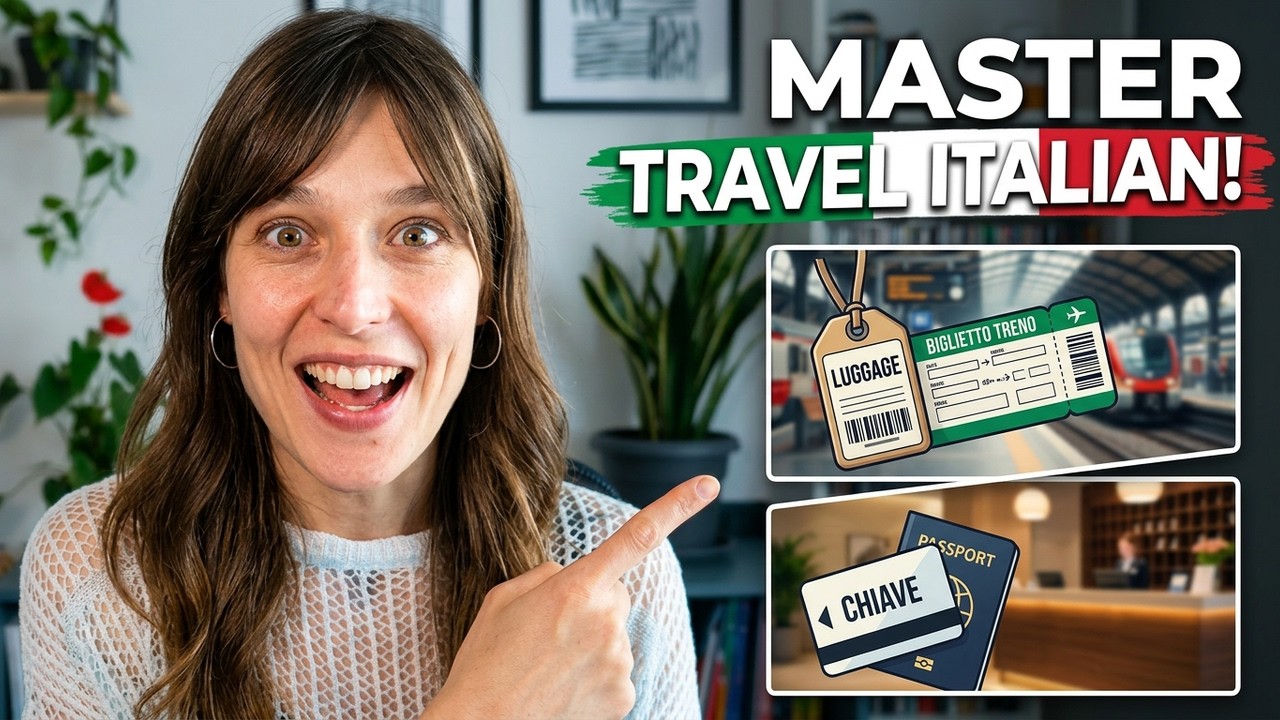
In the video, Maria plays a real A2 dialogue between a guest, Sofia Rossi, and a hotel receptionist. She’s just arrived and is checking in.
Listen once for the general sense, then see if you can answer these five without looking:
- What’s the guest’s name?
- How many nights is she staying, and on what dates?
- What floor is her room on?
- Is breakfast included, and at what time?
- Where’s the dining room?
The answers are all in the video — but here’s the scoring that matters: three out of five on the first listen is a good A2 result. If you only caught the name, the problem is usually the method rather than the Italian — see below.
How to practise so it actually sticks
The order matters more than the material:
- Listen once without reading anything. Only ask yourself who’s talking and where.
- Then read the questions and underline the key words: piano, colazione, notti.
- Listen again, hunting for those specific words.
- Don’t pause the audio. Let it run to the end even when you lose the thread — a real receptionist won’t pause either.
- Only then read the transcript, to find the words you missed.
Reading the questions before the first listen turns the exercise into a word hunt, which is an easier skill and doesn’t transfer to a real reception desk.
Common mistakes
- Expecting primo piano to mean street level. Street level is piano terra; primo piano is one flight up.
- Saying voglio una camera. Correct, but blunt. Use vorrei — “I’d like”.
- Forgetting the ID. Italian hotels are legally required to register your document, so it will be asked for even at a small B&B.
- Confusing camera and stanza. Both mean “room”, but a hotel room is a camera — camera singola, camera doppia, camera matrimoniale (one double bed).
- Assuming breakfast runs all morning. Italian hotel breakfast is usually a tight window, often 7:00–10:00, and then it’s gone.
Where this fits with the rest of your trip
Check-in is one situation out of four or five you’ll hit in the first day. We’ve covered how to order coffee at an Italian bar and buy a train ticket — the two things that happen immediately before and after the hotel — and if you’re staying longer than a holiday, renting an apartment in Italy has the vocabulary for the next step up.
Recap
- Ho una prenotazione a nome… is the only sentence you strictly need to start.
- Piano terra = ground floor. Secondo piano = two flights up.
- Your passport or ID card will be asked for every single time.
- The answer to listen for contains three things: floor, room number, breakfast time.
- Listen for the gist first, for detail second, and read the transcript last.
Not sure where to start? Find out your Italian level.
Take the free quiz and find out in 2 minutes.